What a project means in consulting
What makes a consulting project, how to agree on its outcomes, timeline and responsibilities, and how to assess costs and payback.

In this article
A company can make regular purchases while also changing its purchasing procedures. Day-to-day work needs to keep supplies moving. Changing the process requires an examination of failures, new rules and a check of how those rules work in practice. These tasks need different ways of organising the work.
Within the Consulting service model, work on a defined change is organised as a project. Management needs to understand in advance what the company should receive, which resources will be required and how the result will be accepted. This connects the consultant's services with a specific business task.
Work with a beginning and an end
A project is a temporary undertaking that creates a unique product, service or result. This understanding follows the Project Management Institute (PMI) definition. In consulting, the result may be a financial model, a new purchasing process, a management accounting system or a decision on whether an investment is feasible.
The temporary nature refers to the work itself. The resulting tool or process may be used for years. Even a standard model needs to be adapted to the company's data, constraints and decisions. A project may last several weeks or months. A short duration alone does not determine the type of work.
A project can also end with a well-founded decision to abandon the original idea. For example, calculations may show that a new business line requires funding beyond the company's reach. If assessing feasibility was the agreed task, this conclusion helps avoid unjustified expenditure.
Projects and day-to-day work
The distinction is clear within a single process. Developing and testing a new purchasing procedure means carrying out a change. Collecting requests and placing orders every day means working under that procedure. A project creates or changes the way work is done, while ongoing operations maintain its use.
| Feature | Project | Day-to-day work |
|---|---|---|
| Purpose | Prepare an agreed change | Perform recurring tasks |
| Organisation | Stages and completion conditions | An ongoing working cycle |
| Result | A tested tool, process or well-founded decision | Regular operations and current data |
| Example | Set up a process for planning purchases | Process purchases every day |
What needs to be defined before work begins
A project starts with a clear reason for change. Instead of the broad task “improve purchasing”, a more specific task can be defined: identify the causes of urgent deliveries and prepare a planning procedure to reduce them. The expected benefit needs to be linked to measures that can be checked.
The deliverables are then defined. In this example, they may include planning rules, a request form, allocation of decision-making authority and a trial of the new procedure on a selected product group. It is important to agree in advance whether software configuration, training and employee support during the trial are included.
The scope identifies the departments, data and processes covered by the work. A project may cover one warehouse and selected purchasing categories. Including the remaining warehouses will require a separate assessment. The work included and its boundaries need to be defined in advance. [2]
Alongside the result, the parties agree on the deadline, budget, participants and acceptance criteria. For a new purchasing procedure, the criteria might include requests following the agreed approval route, required data being completed and decisions being traceable against the rules. A list of documents becomes useful when their application is clear.
The budget can usefully show consultant fees, software costs and other external work separately. Employees' time also needs to be planned, even when it does not create additional cash payments. This helps assess the project alongside the team's current workload.
How the work is organised
The sequence depends on the task. In an illustrative six-week project, the first week is devoted to reviewing purchases and the causes of urgent deliveries. Rules are then developed and decision-making authority is assigned. The new procedure is tested on actual purchases, refined and handed over to the team.

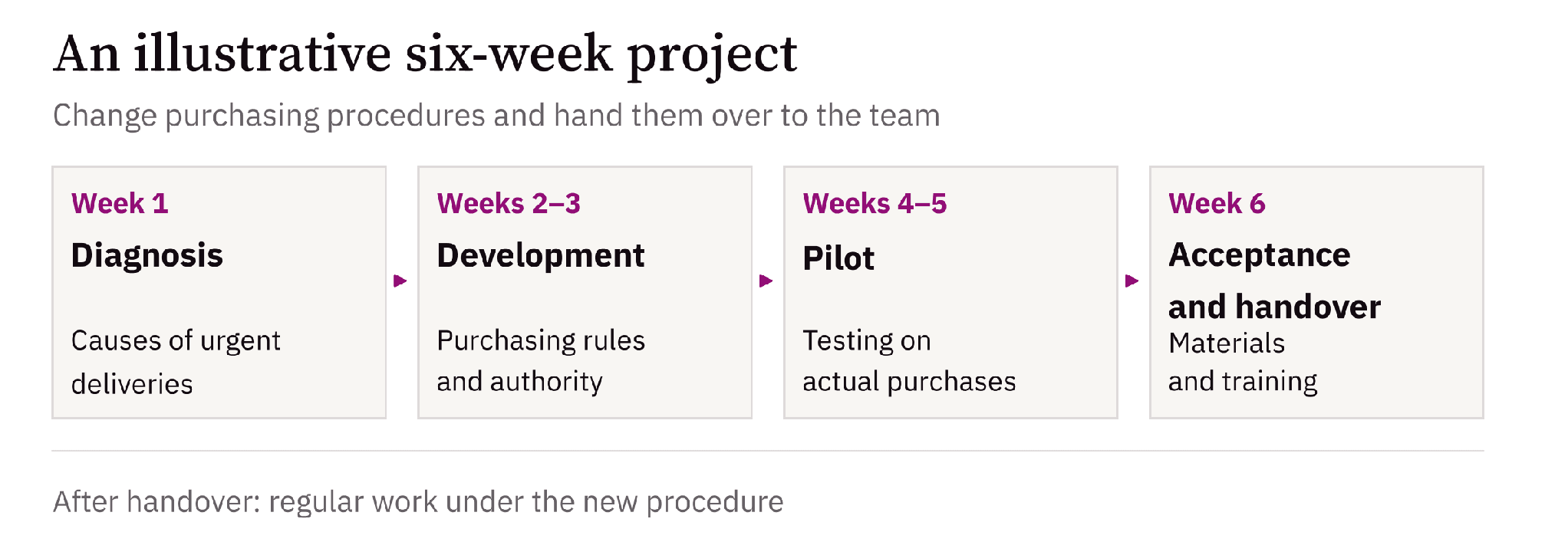
Diagram 1. Illustrative six-week project to change purchasing procedures. The stages and their duration are determined for the specific task.
Testing in practice reveals exceptions before the new process is used widely. If data is missing, a data restoration stage may be needed. The plan is refined while keeping the result and decision-making process clear.
Who makes decisions
The company needs someone responsible for the project's result. This person helps set priorities, ensures access to data and employees, resolves disputed issues and accepts the result. In a small company, the owner or head of a business area may take this role. The person needs the necessary authority.
The consultant organises the analysis, tests assumptions, develops the solution and carries out the agreed part of implementation. Company employees explain how the work is done and take part in testing. This division helps account for the business's actual constraints and prepare procedures the team can use after handover.
Before work begins, the parties need to agree on working arrangements: who provides data, who confirms findings and how quickly questions are reviewed. If a decision requires the owner's participation, that involvement should be included in the project plan.
How the scope changes
New tasks may emerge during the work. For example, a proposal to include a second warehouse may follow the analysis of the first. This changes the volume of data, the number of participants, the checks and the training required. Before the new task is included, its impact on the result, deadlines and budget needs to be assessed.
Following that assessment, management may expand the project, change priorities or establish a separate stage. The decision should be recorded together with the updated terms. This allows additional work to be chosen deliberately and keeps the agreement clear. Revising the original decision may be justified if new data points to a more useful option.
How the result is checked
The project's result and the later benefit to the business are connected, but measured differently. When a new purchasing procedure is handed over, it is possible to check whether the rules can be applied, employees understand their authority and requests follow the agreed route. Savings on deliveries then need to be confirmed using comparable data.
APM distinguishes the results of changes from the benefits they generate. Some benefits appear after the change enters regular use. It is therefore useful to define the baseline measures, observation period and responsibility for further assessment before the project begins. [3]
If achieving a specific performance target is part of the acceptance criteria, it must be checked within the agreed period. Handing over documents does not replace that check. At the same time, a longer period over which savings accumulate can be assessed separately from the completion of implementation work.
Illustrative example of project economics
In an illustrative scenario, a company plans to change purchasing over six weeks. One-off cash expenditure on the project and implementation totals UZS 144 million. After implementation, monthly payments for urgent deliveries are expected to fall from UZS 60 million to UZS 36 million, with the same volume of work and delivery quality.
The reduction in payments is UZS 24 million a month. Additional payments for the software service and its support will be UZS 6 million a month. Estimated net cash savings are UZS 18 million: 60 − 36 − 6. If these savings continue, the one-off expenditure will be recovered over eight full months after implementation: 144 ÷ 18.

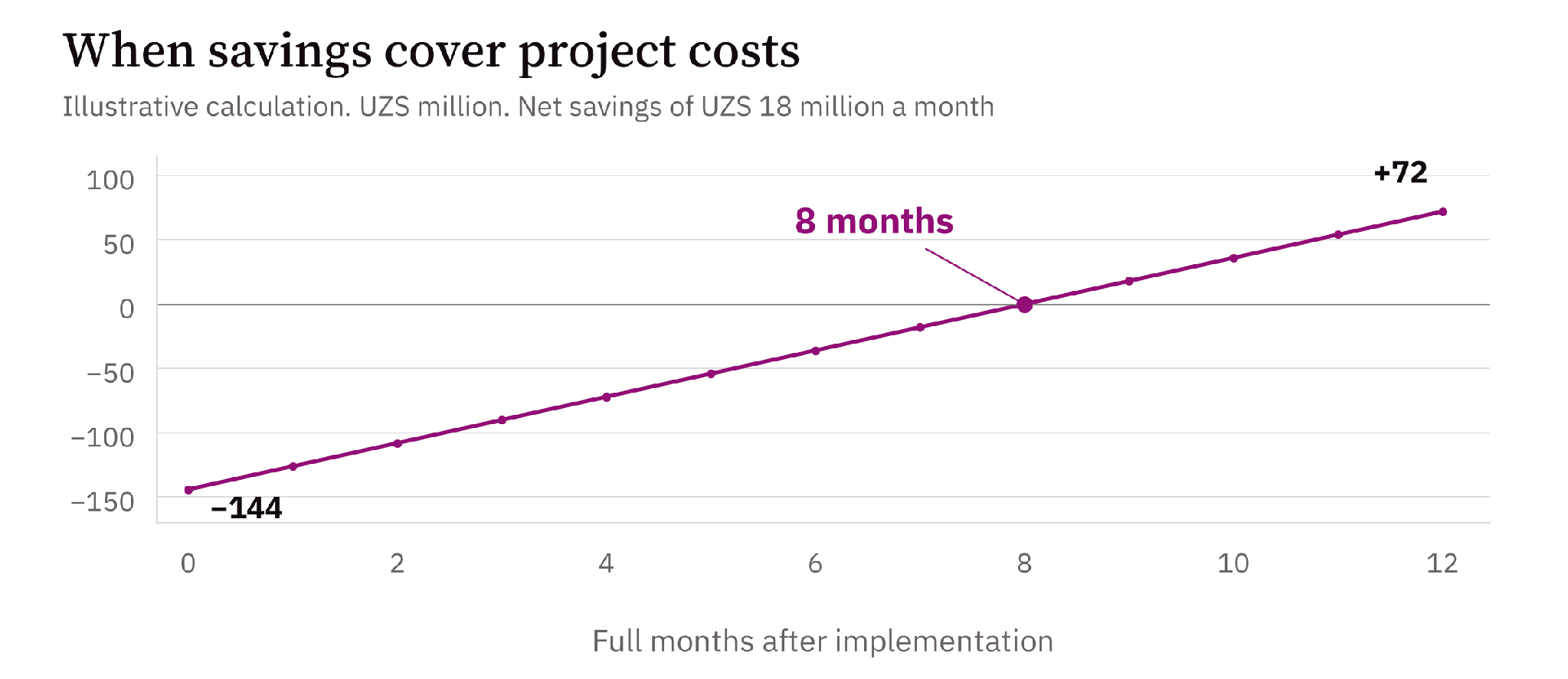
Chart 1. Illustrative cumulative net cash benefit, UZS million. At month zero, implementation is complete and UZS 144 million has already been paid. Each subsequent full month adds UZS 18 million of estimated savings.
The six weeks relate to carrying out the project, while the eight months relate to accumulating savings after implementation. The full period from the start of work will be longer than eight months. The calculation assumes that payment reductions start immediately after implementation and remain unchanged. Taxes and the time value of money are excluded.
This scenario supports a decision on whether the expenditure is worthwhile. The actual effect needs to be checked. Payments may have changed because of purchasing volumes, delivery rates or other circumstances. A fair comparison needs to account for these differences and the costs of maintaining the new procedure.
Acceptance and handover
Project completion is confirmed by checking the agreed results. In this example, the rules need to be accessible to employees, roles defined and the procedure tested. Significant issues identified during testing must have been resolved, or a way to close them must have been agreed. The company receives the materials and knowledge needed for further work.
Responsibility after handover is defined separately, including updating rules, dealing with exceptions and monitoring measures. These functions may be performed by the internal team or an external provider under ongoing support. This helps maintain the changes in daily work. A separate project is not always required before an ongoing support arrangement.
When the internal team is enough
A project can be organised internally if the company has the necessary knowledge, time and a manager responsible for the work. An external consultant is useful when a significant change requires additional expertise, independent review or coordination between several departments.
The level of project management should match the task. For a small change, a short plan, a responsible person and a clear check may be sufficient. Where there is a persistent shortage of people to do the work, hiring or ongoing support is worth assessing. If the cause of the difficulties is unclear, the first project stage may be a diagnostic review followed by a decision on further action.
What the project model gives a company
A project connects a management task with a defined result, resources and responsibility. The client understands what the expenditure is for and how the completed work will be checked. The team receives a solution ready for use, together with procedures for applying it. This provides a basis for informed decisions, managed implementation and later assessment of the business benefit.
Sources
1. Project Management Institute. What is a project.
2. Association for Project Management. What is scope management.
3. Association for Project Management. Benefits management and project success.