Financial and management consulting for business
How financial and management consulting differ, when a business needs an external specialist, and how to assess results using practical examples.


In this article
A company is increasing sales, yet its owner finds it harder to understand how much profit it makes. Employees are busy, but orders are delayed. Before launching a new business line, it is unclear whether there will be enough money and people. In these situations, management needs data, an examination of the causes and a comparison of possible solutions. A consultant can take on this work.
Financial and management consulting help explain how a business operates and prepare it for change. The client needs to understand the focus of each field, define the expected result in advance and decide whether bringing in an external specialist is justified.
What consulting means
Consulting is professional support in addressing a specific business task. A consultant studies the situation, checks the data, identifies the causes of difficulties and proposes well-founded courses of action. If agreed, the consultant also helps implement the solution and assess its results.
The reason for seeking support may be a problem, such as falling profit, or a new opportunity, such as entering another region. In both cases, the work starts with a management question. The phrase “improve efficiency” is too broad. The task “identify why orders are delayed and reduce their processing time” provides a clear focus for analysis.
How consulting differs from hiring an employee
An employee is hired for an ongoing role within the company. The specialist manages an area of work, handles recurring tasks and builds knowledge of the business. This arrangement is suitable when the team needs that expertise every day.
A consulting project is organised around a specific task and an agreed result. A consultant may review a financial model, identify the causes of delays or design a new management process. The specialists involved and the length of their involvement depend on the task. At the end of the project, the company receives the analysis, tools and procedures for the team to use them.
For example, an in-house finance specialist prepares monthly reports and plans payments. A consultant can be engaged to develop an accounting methodology, review an expansion model or help reorganise the finance function. The team then applies the solutions, or this work becomes part of a separate ongoing support arrangement.
An employee can also carry out analysis and implement changes. The choice depends on the complexity of the task, the team's workload and the knowledge available. If the work is needed continuously, hiring is worth considering. If a particular change requires specialist expertise, consulting may be useful.
How the consulting process works
First, the client and consultant agree on the task, scope of work, deadlines, data required and criteria for assessing the result. The consultant then reviews documents, discusses the work with employees and tests assumptions. It is important to distinguish a visible symptom from its cause. A shipment may be delayed because stock is unavailable, approvals are repeated or planning is inadequate.
After the diagnostic review, the parties compare possible changes, their costs and their limitations. They assign internal responsibility for implementation and agree on how to check the outcome. The consultant may support this stage. Management approves decisions, allocates resources and ensures the team's participation. This approach helps connect recommendations with changes in day-to-day work.

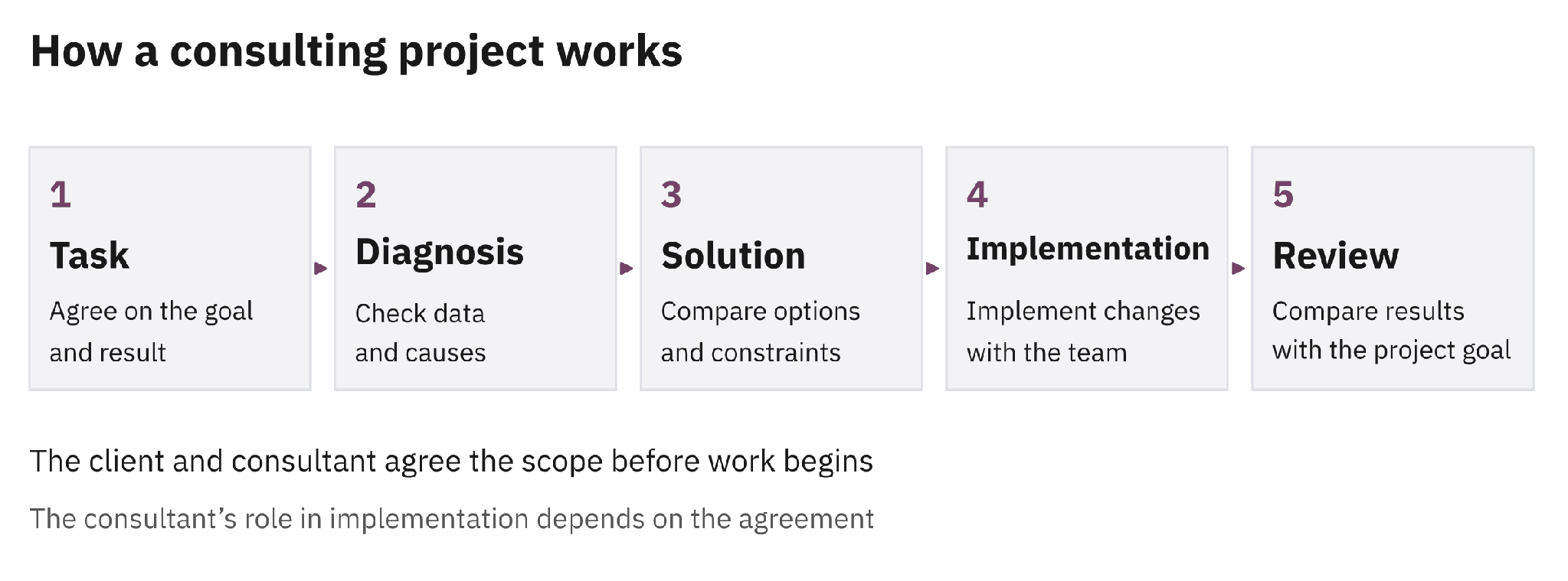
Diagram 1. The work centres on the client's task and verification of the result. The stages depend on the project.
What financial consulting addresses
Financial consulting helps management assess decisions through their impact on profit, cash flow and funding needs. It may cover product costs, pricing, budgets, inventory, customer receivables or investment in growth.
For example, before expanding, a company needs to estimate the initial investment, ongoing expenses and additional cash buffer. Sales and cash receipts may fall on different dates. The consultant therefore checks both expected profit and whether enough cash will be available for mandatory payments. A financial model and cash flow forecast support this assessment.
This field connects calculations with management decisions. A useful result may include a model with verifiable inputs, a comparison of scenarios and recommendations on the chosen option. Financial consulting does not replace statutory accounting. Accounting data can provide a basis for analysis, but it needs to be checked and broken down in sufficient detail.
Illustrative example of how costs affect profit
In an illustrative example, a company's monthly revenue is UZS 1 billion and its total expenses before corporate income tax are UZS 900 million. Profit before tax is UZS 100 million. One major expense category accounts for UZS 500 million of those expenses.
If that category can be reduced by 4%, the saving will be UZS 20 million: UZS 500 million × 4%. With revenue and other expenses unchanged, profit will increase to UZS 120 million, a rise of 20%. Total expenses will fall from UZS 900 million to UZS 880 million.

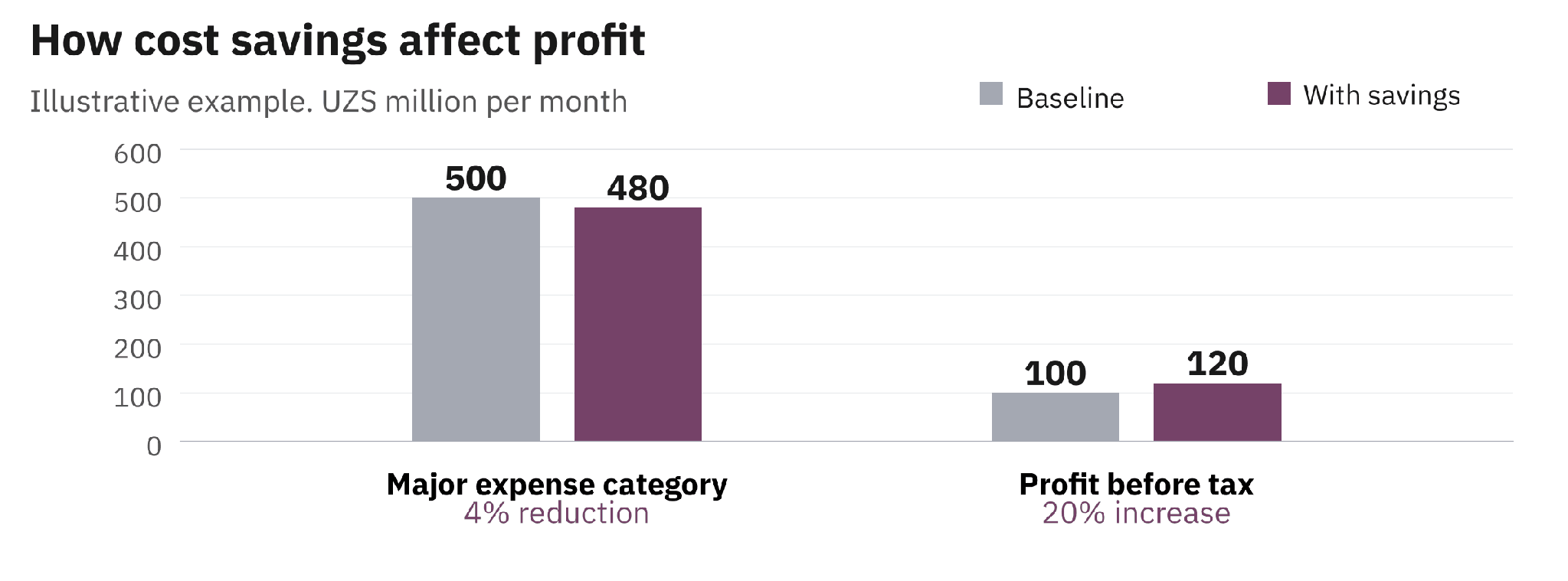
Chart 1. Illustrative monthly calculation. A major expense category falls from UZS 500 million to UZS 480 million (4%), while profit before tax rises from UZS 100 million to UZS 120 million (20%). Revenue and other expenses remain unchanged.
This calculation indicates which expense category warrants closer examination. Before a decision is made, it is necessary to check whether the saving is achievable and how it would affect quality and sales. The costs of implementing the changes also need to be included in the calculation.
What management consulting addresses
Management consulting helps organise how a company works, including responsibility, coordination between departments, decision-making and business processes. It is needed when results depend on how people and resources work together. It can also cover strategy, organisational structure and change management.
For example, the owner approves almost every request. When the owner is busy, employees wait, even though most cases could be handled under agreed rules. The consultant examines the approval route, the reasons for repeated checks and the risks of delegation. The consultant then recommends how decision-making authority should be allocated and proposes an approval process and monitoring methods.
This field requires changes to people's daily work. A new organisation chart alone does not specify who resolves a disputed decision or how to handle an exception. A project may therefore deliver clear working procedures, delegated authority, team training and a process tested on real tasks.
Illustrative example of a workflow change
A company processes 40 standard requests a week. An employee spends 15 minutes processing each request. Total staff time is 600 minutes, or 10 hours a week. After duplicate data entry is removed and the new procedure is tested, the target is 5 minutes per request.
For the same number of requests, this equals 200 minutes, or 3 hours 20 minutes a week. The estimated time released is 400 minutes, or 6 hours 40 minutes. The measure here is an employee's processing time, rather than the full time a request spends waiting.

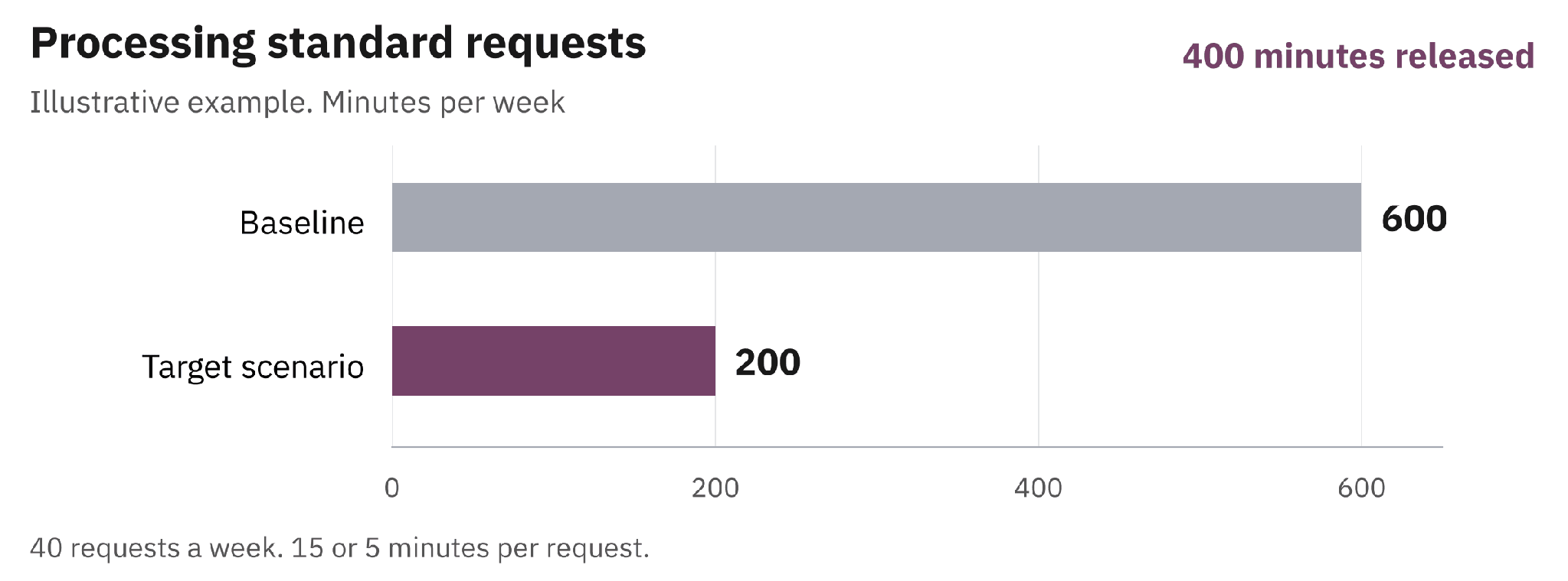
Chart 2. Illustrative staff time for 40 requests a week. The target scenario needs to be tested in practice. Releasing staff time does not, by itself, mean a cash saving.
This time can be assigned to other tasks. Achieving a financial benefit requires a decision on how to use the available capacity and an assessment of the costs of the changes. Sales will not grow automatically simply because requests are processed faster.
How the two fields connect
Separating financial and management consulting helps define the task, but the two often overlap in practice. Financial analysis may reveal rising costs for urgent deliveries. A process review may show that late purchasing approvals are the cause. A lasting result will require changes to planning and employees' authority.
| Comparison | Financial consulting | Management consulting |
|---|---|---|
| Main question | How a decision affects profit and cash | How to organise work to achieve the required result |
| Typical tools | Models, budgets, cost and cash flow analysis | Process analysis, allocation of roles and decision-making authority |
| Example of verification | Actual savings with sales volume maintained | Staff time, completion times and number of errors |
Financial calculations help assess the consequences of organisational changes. Process improvements help realise the opportunities identified in the figures. It is useful for the client to start with a specific task and choose the combination of expertise that it requires.
When consulting services are useful
External support is justified when a company faces a significant task but lacks specialist knowledge, time or an independent review. For example, the team cannot explain falling profit, departments disagree on the causes of delays, or several expansion scenarios need to be compared.
A recurring problem is another reason to seek support. A company may repeatedly cover cash shortages with short-term loans without changing payment and purchasing terms. Or a manager may keep intervening in the same approvals. In these cases, examining how the work is organised can help address the source of repeated difficulties.
Company size alone does not determine whether consulting is needed. The complexity of the task, the consequences of an error and the ability to use the recommendations matter more. A focused project with a clear result may be more useful than a broad review of the entire business.
When the task is better handled internally
If the cause is clear and the team has the skills and time, assigning a responsible person and carrying out the work may be sufficient. A full consulting project may be excessive for correcting a one-off error or updating a familiar report.
If there is an ongoing shortage of people to do the work, hiring or outsourcing recurring tasks is worth considering. If employees do not know an established procedure, training may be enough. A consultant is needed when the task requires investigation, a solution needs to be designed or changes need to be carried out.
Where reliable data is missing, restoring it may be a sensible first step. If management is not ready to appoint a responsible person, provide information or discuss changes, a full project is best postponed. In an urgent situation, such as delayed mandatory payments, immediate action cannot wait for a large study to be completed.
How clients can assess the result
Before work starts, it is useful to record the baseline, the expected change and how it will be verified. For a financial task, this may be the cash requirement or actual savings. For an organisational task, staff time, completion times and error rates may be appropriate. The measures must relate to the project's task.
The company should also define exactly what it will receive: a diagnostic review, a model, a change plan or implementation support. These are different deliverables and require different levels of consultant involvement. The agreement should specify how materials and knowledge will be handed over and who will be responsible for applying them afterwards.
The economic result needs to take account of service fees, employees' time and implementation costs. Released hours cannot automatically be treated as a reduction in payroll costs. Changes in profit after a project also need to be examined, since prices, seasonality and sales volumes may have influenced them.
For the client, the value of consulting lies in defining the problem more precisely, comparing solutions and organising change. Good work leaves the company with clear calculations, practical rules and knowledge that the team can continue to use. This helps management choose actions in light of their expected effect, the resources required and the risks involved.