
Simplified 6% VAT under PF-100: when switching makes a difference
Who may benefit from simplified 6% VAT, where tax risks arise and how to compare regimes using a UZS 10 billion revenue example.


In this article
From 1 June 2026, PF-100 gives some businesses in catering, retail, and services a voluntary simplified VAT regime. The regime runs until 1 January 2030. Its logic looks simple: VAT at 6% of turnover, profit tax at 0%, and less reporting. However, the financial result depends on margin, input VAT, the customer mix, and the ability to change prices, rather than the headline rate alone.
The short conclusion: the 6% regime is more likely to benefit companies with high value added and a small share of VAT-bearing purchases. For low-margin trading businesses, importers, and B2B companies with substantial input VAT, the general regime may be more favourable.
What changes
Under the simplified regime, a company pays VAT at 6% on its entire turnover and does not pay profit tax. Input VAT on purchases cannot be credited, VAT exemptions do not apply, and an accumulated negative VAT balance is written off. Customers retain the right to credit VAT on purchases from these businesses.
Under the general regime, the tax burden combines 12% output VAT less input VAT and 15% profit tax. The owner’s key question is therefore not “6% or 12%”, but “how much net profit remains after all taxes and the loss of input credits”.
Comparing three scenarios
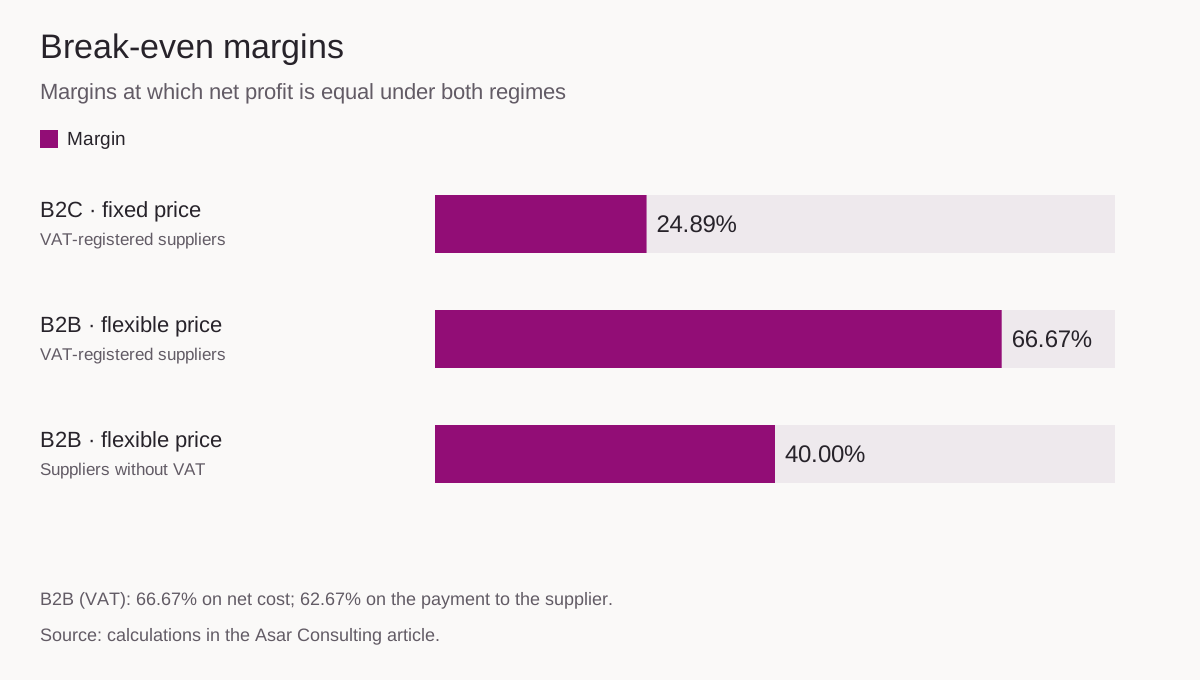
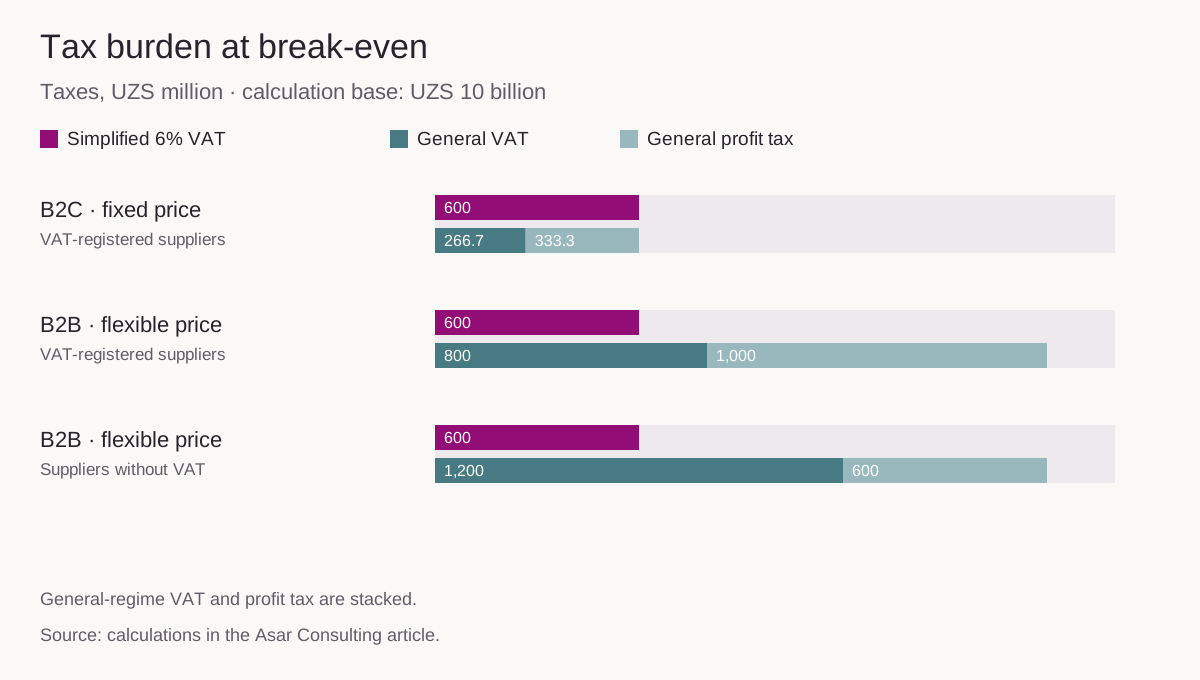
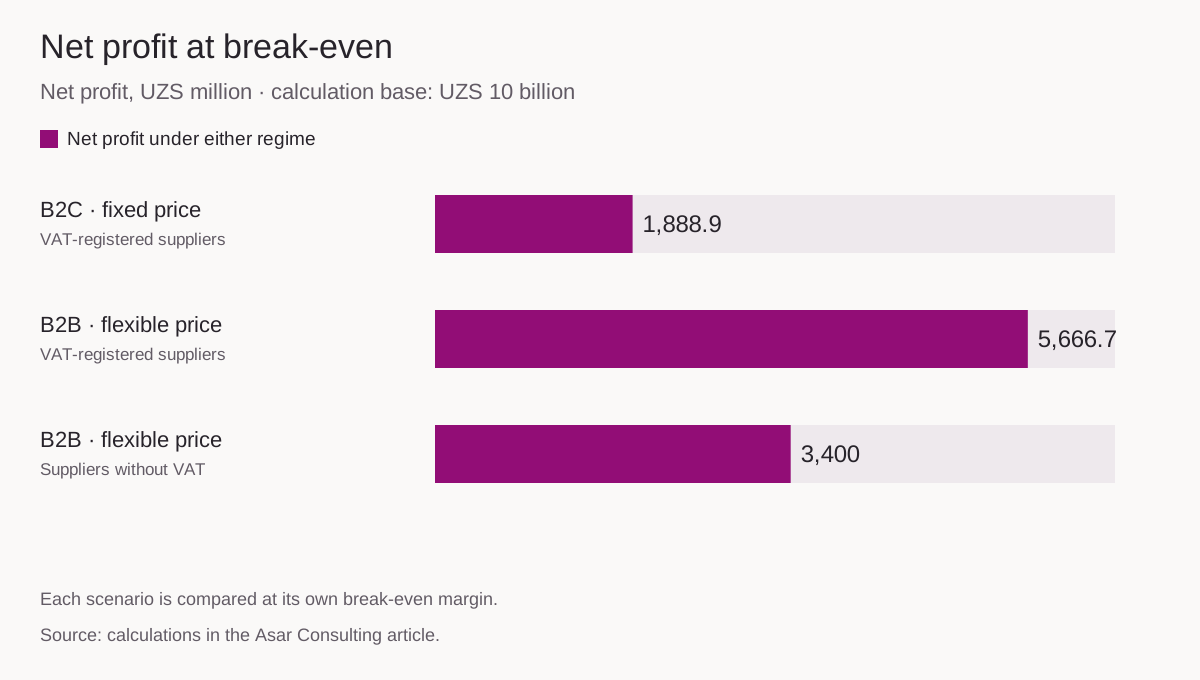
The calculations below use a base of UZS 10 billion. The break-even point is the margin at which net profit is the same under the simplified and general regimes.
| Scenario | Commercial logic | Break-even point | 6% VAT | VAT under the general regime | Profit tax under the general regime | Net profit at the break-even point |
|---|---|---|---|---|---|---|
| B2C, fixed final price, VAT-registered suppliers | The market sets the final price; VAT cannot simply be added on top | 24.89% | 600 million | 266.7 million | 333.3 million | 1,888.9 million |
| B2B, flexible price, VAT-registered suppliers | The buyer credits VAT, so the VAT-exclusive price matters | 66.67% of net cost, 62.67% of payment to the supplier | 600 million | 800 million | 1,000 million | 5,666.7 million |
| B2B, flexible price, suppliers without VAT | Purchases carry no input VAT, reducing part of the general regime’s advantage | 40.00% | 600 million | 1,200 million | 600 million | 3,400 million |
How to read the results
B2C with a fixed price. In retail and parts of catering, the customer sees a final price. If the margin exceeds 24.89%, simplified 6% VAT may improve net profit. Below that margin, input VAT credits under the general regime begin to outweigh the zero profit tax rate.
B2B with VAT-registered suppliers. This scenario calls for the greatest caution before switching. If the company can add 12% VAT to its price and the buyer credits it, the general regime retains a strong advantage through input VAT. The simplified regime becomes financially attractive only at a very high margin: around 66.67% of net cost.
B2B with suppliers without VAT. For services, consulting, marketing, IT, agency, and project businesses, the conditions are less restrictive. When a significant share of costs carries no input VAT, the general regime provides fewer credits. In this model, the break-even margin is 40%.
Which businesses may benefit
Consider switching if the business has a high margin, creates substantial value internally, and incurs expenses with little input VAT. Practical candidates include high-markup catering businesses, services, consulting, some retailers, and companies whose costs include staff, rent, marketing, services, and contractors without VAT.
Model the regime particularly carefully for low-margin trading businesses, importers, wholesale B2B companies, businesses with large purchases from VAT payers, accumulated negative VAT balances, VAT exemptions, or substantial inventories and long-term assets.
What to check before notification
Before switching, the finance team should prepare a short model for each business area covering:
- actual margin over the last 12 months;
- the shares of B2C and B2B sales;
- purchases from suppliers with and without VAT;
- average input VAT available for credit;
- the accumulated negative VAT balance;
- exemptions and preferences that would be lost;
- inventories and long-term assets;
- contract terms: VAT-inclusive or VAT-exclusive prices and the buyer’s right to input credits;
- cash flow under base, stress, and optimistic scenarios;
- the consequences of a possible return to the general regime.
Conclusion
Simplified 6% VAT under PF-100 is a management choice, rather than a universal concession. It may be beneficial where profitability is high, input VAT is limited, and customer pricing preserves the commercial model. It may be risky where the economics depend on VAT credits, imports, low margins, or tax exemptions.
Make the decision only after calculations based on your own revenue, cost of sales, suppliers, customers, contracts, and asset balances. The 6% rate looks simple, but the effect depends on the entire business model.